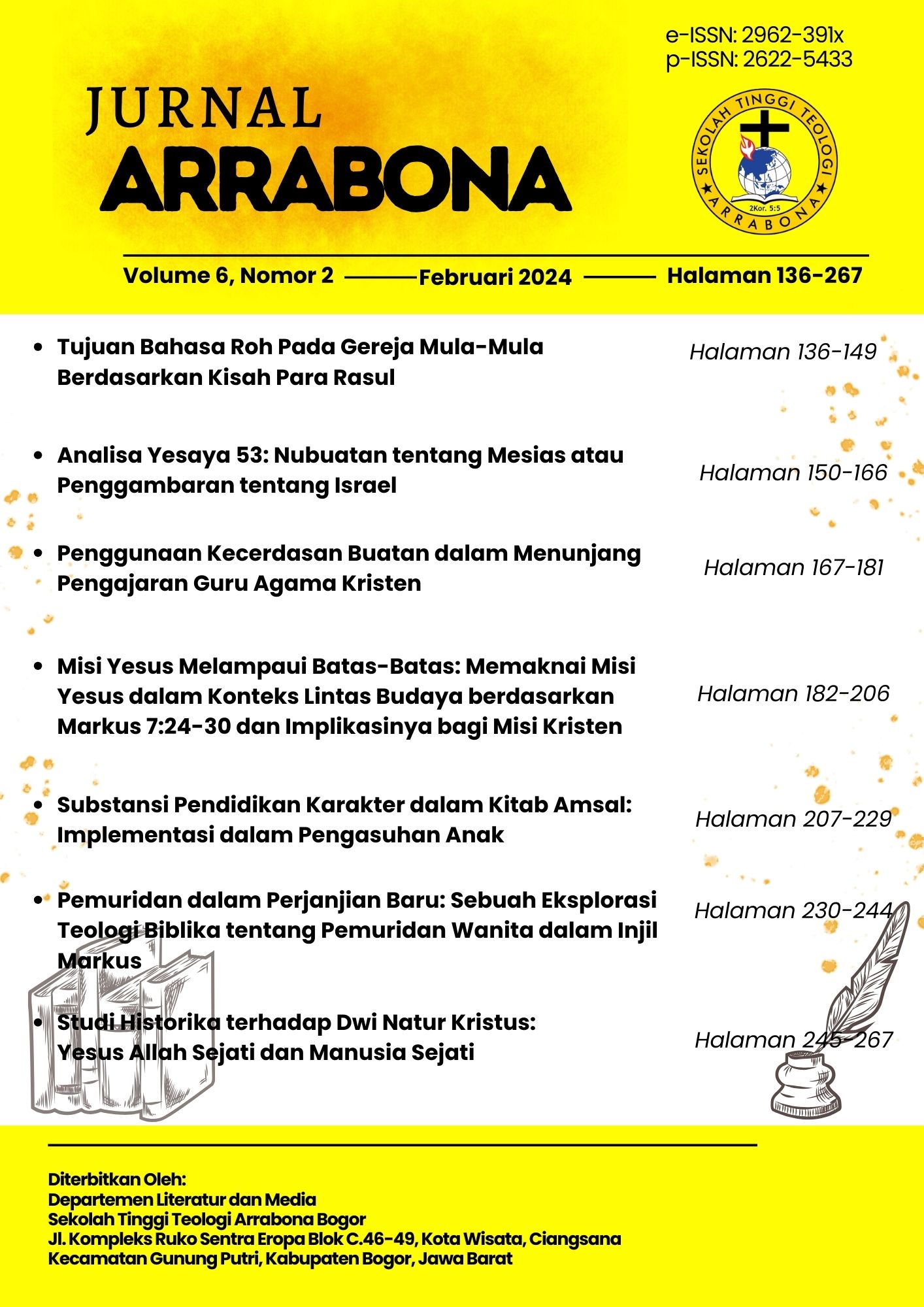
Tujuan Bahasa Roh Pada Gereja Mula-Mula Berdasarkan Kisah Para Rasul
DOI:
https://doi.org/10.57058/juar.v6i2.105Keywords:
Purpose of Tongue Language, Gospel Preaching, ActsAbstract
Tongue is a gift given by God through the power of the Holy Spirit. Tongues come from God and are given to those who truly believe in God. Gifts are complements that God gives freely to people who truly believe so they can serve others for the glory of God, gifts to serve with the aim that others will be saved. True tongues come from the Holy Spirit and are not memorized. All good gifts come from God, when you are filled with the Holy Spirit you must live truly believing in Jesus Christ. The research method used is literature review or library research, namely library searches, utilizing library sources to obtain the data needed by the author in the research. Library research focuses on library collection materials without using field research. The aim of the research is to provide a more comprehensive and biblical understanding of the purpose of tongues according to the Acts of the Apostles. The results of the research obtained regarding the purpose of tongues based on the Acts of the Apostles are that tongues are used to preach the Gospel by reporting the great deeds of God, tongues are used to glorify God, tongues are a sign of baptism and tongues produce life in harmony.
References
“Arti Kata Bahasa Roh Menurut Kamus KBBI Online, Makna Kata Dari Kamus Besar Bahasa Indonesia,” n.d.
Barbara, Ns Laksita. “Systematic Review Dalam Kesehatan: Langkah Demi Langkah,” 2020.
Bennett, Dennis J. “How to Pray for the Release of the Holy Spirit : What the Baptism or Release of the Holy Spirit Is, and How to Pray for It,” 1985, 119.
Brian J Vickers. “Apa Itu Lidah Api? (Kisah Para Rasul 2).” Crossway, 2019.
Fu, Timotius. “Bahasa Roh Menurut Calvin Dan Implikasinya Bagi Gereja Masa Kini,” 2009.
Hasan Susanto. Perjanjian Baru Interlinear Yunani-Indonesia Dan Konkordansi Perjanjian Baru (PBIK) Jilid I. Jakarta: Lembaga Alkitab Indonesia, 2014.
———. Perjanjian Baru Interlinier Yunani-Indonesia Dan Konkordansi Perjanjian Baru Jilid I, II. Malang: Literatur SAAT, 2014.
Henry, Matthew, and Leslie F Church. “Commentary on the Whole Bible: Genesis to Revelation PC Study Bible Formatted Electronic Database.” By Biblesoft, Inc.All Rights Reserved, 2006.
Hermanto Suanglangi. “Bahasa Roh: Apa Dan Bagaimana?” Vol. 2, No (2004): 17–25. https://doi.org/DOI: http://dx.doi.org/10.25278/jj71.v2i1.146.
Joel N. Musvosvi. “Fungsi Karunia Bahasa Roh Dalam Kitab Kisah Para Rasul.” International Journal for Pastors, n.d.
“JURNAL TEOLOGI DAN PELAYANAN KRISTIANI Vol 2, No 2, Desember 2022; 132-149 e-ISSN 2798-2084 Available at: Https://Www.Stttorsina.Ac.Id/Jurnal/Index.Php/Miktab/ - Penelusuran Google,” n.d.
Lewis Johnston. “Karunia Bahasa Roh Dalam Kitab Kisah Para Rasul.” plymouthbrethren, n.d.
Matthew E. Carlton. Kisah Para Rasul Terjemahan Khusus Dan Pendalaman Alkitab. Jakarta: Yayasan Karunia Bakti Budaya Indonesia, 2002.
Mau, Marthen. “Makna Glossalalia Menurit Kisah Para Rasul 2:1-13 Dan Implikasi Urapan Roh Kudus Bagi Mahasiswa Teologi.” Veritas Lux Mea 3, no. 1 (2021): 46–57.
Nicolas, Djone Georges. “Analisis Model Pelayanan Jemaat Mula-Mula Berdasarkan Kisah Para Rasul: Suatu Teladan Bagi Gereja Masa Kini.” Formosa Journal of Multidisciplinary Research 1, no. 3 (2022): 521–32.
Pelayan, Pemahaman, Tentang Karunia, and Bahasa Roh. “J t s 2022” 11, no. September 2021 (2022): 69–75.
“Reinhard Bonke, Mighty Manifestations (Surabaya: Majesty Books Publisher, 2006), 243. - Penelusuran Google,” n.d.
Romadhon, Mohamad. “Dampak Pencurahan Roh Kudus Dalam Kisah Para Rasul Bagi Pembentukkan Karakter Mahasiswa STT Galilea Indonesia” 5, no. 1 (2023): 22–41.
Santosa, Eka Budhi. “Dinamika Roh Kudus Dalam Ibadah Pentakosta.” Jurnal Antusias 2, no. 1 (2012): 180–202.
“Semeyna and Schmaltz, “‘Glossolalia Meets Glosso-Psychology: Why Speaking in Tongues Persist in Charismatic Christian Anad Pantecostal Gathering,’ n.d, 40.,” n.d.
Setiawan, Iwan, Elisabeth Ngana Hama Ayli, Chresty Thessy Tupamahu, Elri Masniari Saragih, and Risart Pelamonia. “Menyelesaikan Pekerjaan Tuhan Berdasarkan Yohanes 4: 34.” Manna Rafflesia 8, no. 2 (2022): 423–48.
Setiawan, Iwan, and Reagen Petrus Banea. “Kontekstualisasi Menurut Kisah Para Rasul 17: 16-34.” Te Deum (Jurnal Teologi Dan Pengembangan Pelayanan) 12, no. 2 (2023): 359–78.
Siahaan, Harls Evan R. “Bahasa Roh Dan Spiritualitas Perikoresis Dalam Peristiwa Pentakosta: Analisis Reinterpretatif Kisah Para Rasul 2:1-13.” Logia: Jurnal Teologi Pentakosta 2, no. 2 (2021): 18–31.
Suanglangi, Hermanto. “Bahasa Roh: Apa Dan Bagaimana?,” n.d.
Williams, David J. Acts (Understanding the Bible Commentary Series). Baker Books, 2011.
Wright, Tom. “Kisah Para Rasul Untuk Semua Orang.” Jakarta: Perkantas, 2011.
Yune Sun park. TAFSIRAN ALKITAB KISAH PARA RASUL. batu, malang: Departement Literatur YPPII, 2001.
Zed, Mestika. Metode Penelitian Kepustakaan. Yayasan Pustaka Obor Indonesia, 2008.
Downloads
Published
How to Cite
Issue
Section
License
Copyright (c) 2024 Jurnal Arrabona

This work is licensed under a Creative Commons Attribution-ShareAlike 4.0 International License.

This work is licensed under a Creative Commons Attribution 4.0 International License.