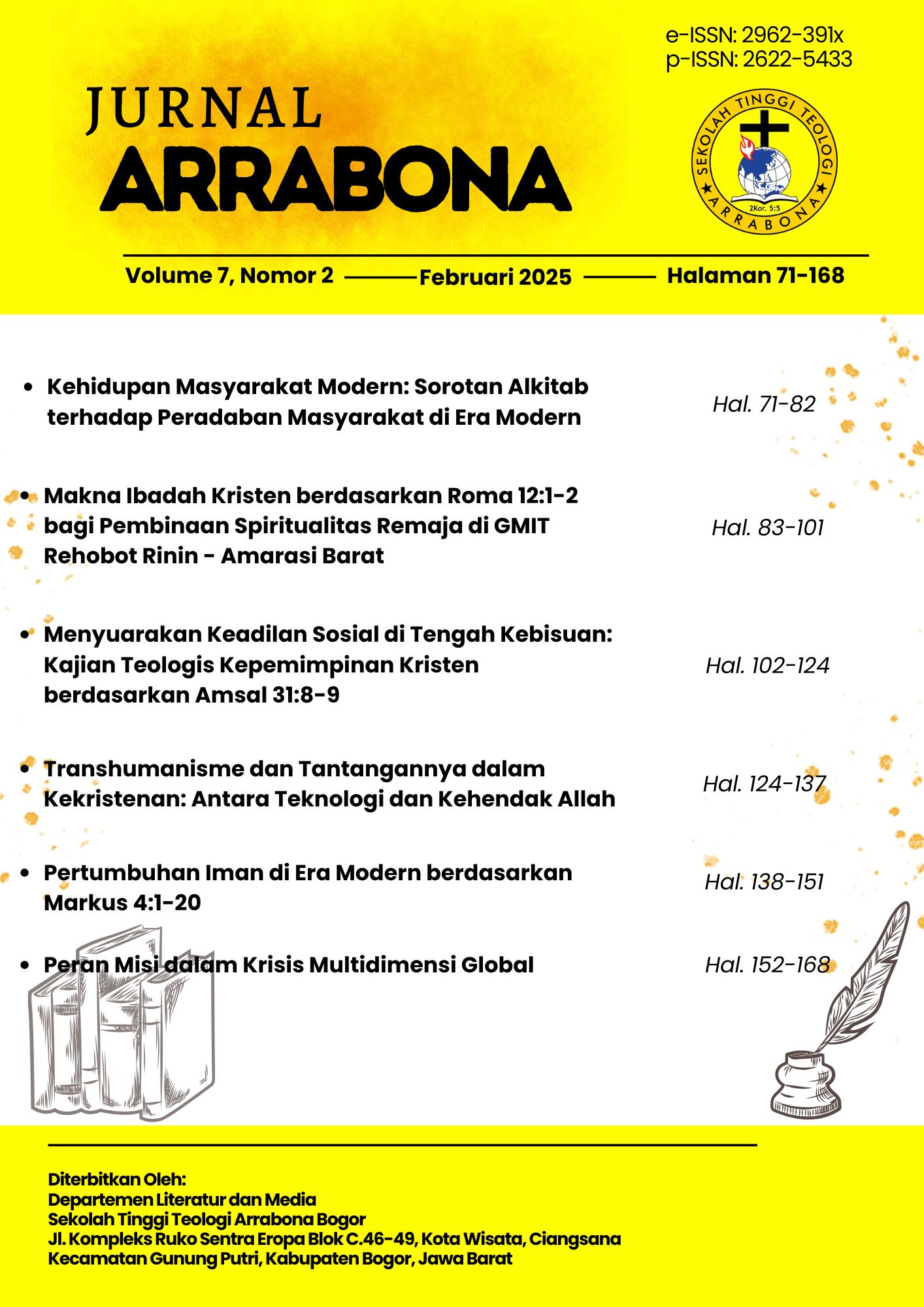
Transhumanisme dan Tantangannya dalam Kekristenan: Antara Teknologi dan Kehendak Allah
DOI:
https://doi.org/10.57058/juar.v7i2.137Keywords:
Transhumanism, Technology, God's Will, ChristianAbstract
Transhumanism is a philosophical and cultural movement that focuses primarily on transcending the biological limitations of humans through technological advancement. In the Christian context, transhumanism poses a number of theological, moral, and spiritual challenges. Many Christian thinkers are concerned that transhumanism could undermine the traditional understanding of humans as creatures created in the image of God, and threaten the moral and ethical values that underlie Christian teaching. Drawing on figures such as Ray Kurzweil and Nick Bostrom, as well as a review of recent literature, this article seeks to answer the fundamental question: how can Christianity respond to attempts to replace dependence on God with dependence on technology? It also offers insights into how the church can play a critical role in guiding people in the face of technological advancement. The result is that the church needs to re-teach the values of the Imago Dei, the church needs to become a place for discussion of God's will for humanity as a central theme in Christian theology that includes understandings of creation, purpose of life, salvation, the end of time and human relationship with God.
References
Adnan, Asif. “Techno-Jahiliyyah: Examining Transhumanism Through The Islamic Lens.” Al-Shajarah: Journal of the International Institute of Islamic Thought and Civilization (ISTAC), December 2, 2024, 167–203. https://doi.org/10.31436/shajarah.vi.1934.
Babich, Babette. “Gnosticism, Political Theory and Apocalypse: Jacob Taubes and Günther Anders, Tracy Strong and Carl Schmitt.” Philosophy & Social Criticism, October 6, 2023. https://doi.org/10.1177/01914537231203551.
Baito, Linus. “Hasrat Transhumanisme Di Tengah Pandemi Covid-19: Sebuah Upaya Memahami Identitas Diri Melalui Pendekatan Teologi Interkultural.” KURIOS 7, no. 2 (October 7, 2021): 217. https://doi.org/10.30995/kur.v7i2.294.
BÉLAND, JEAN-PIERRE, and JOHANE PATENAUDE. “Risk and the Question of the Acceptability of Human Enhancement: The Humanist and Transhumanist Perspectives.” Dialogue 52, no. 2 (June 6, 2013): 377–94. https://doi.org/10.1017/S0012217313000607.
Bostrom, Nick. “Introduction—The Transhumanist FAQ: A General Introduction.” In Transhumanism and the Body, 1–17. New York: Palgrave Macmillan US, 2014. https://doi.org/10.1057/9781137342768_1.
Cordeiro, José. “The Boundaries of the Human.” World Futures Review 6, no. 3 (September 2, 2014): 231–39. https://doi.org/10.1177/1946756714555916.
dein, Simon. “Transhumanism and Health: A Christian Perspective.” Journal of Religion and Theology 3, no. 4 (2019): 11–18. https://doi.org/10.22259/2637-5907.0304002.
Dumsday, Travis. “Transhumanism, Theological Anthropology, And Modern Biological Taxonomy.” Zygon® 52, no. 3 (September 18, 2017): 601–22. https://doi.org/10.1111/zygo.12346.
Iuga, Ion. “Transhumanism Between Human Enhancement and Technological Innovation.” Symposion 3, no. 1 (2016): 79–88. https://doi.org/10.5840/symposion2016315.
Kilner, John. Dignity and Destiny: Humanity in the Image of God. Illinois: Wm. B. Eerdmans Publishing, 2015.
Kornu, Kimbell. “Transfiguration, Not Transhumanism: Suffering as Human Enhancement.” The Heythrop Journal 63, no. 5 (September 11, 2022): 926–39. https://doi.org/10.1111/heyj.14129.
Krcunović, Dušan. “Paul’s Idea of the ‘New Man’ and Transhumanism.” Akropolis: Journal of Hellenic Studies 5 (November 17, 2021): 62–69. https://doi.org/10.35296/jhs.v5i1.77.
Lee, Seung Chun. “An Integrated Perspective of Humanism and Supernaturalism for Education: C. S. Lewis’s Version of Education.” Interchange 43, no. 2 (May 15, 2013): 95–111. https://doi.org/10.1007/s10780-013-9187-x.
Leidenhag, Mikael. “Saved through Technology: Exploring the Soteriology and Eschatology of Transhumanism.” Religion Compass 14, no. 11 (November 23, 2020): 1–9. https://doi.org/10.1111/rec3.12377.
Ross, Benjamin. “Engaging with Transhumanism.” In The Philosophy of Transhumanism, 37–71. Emerald Publishing Limited, 2020. https://doi.org/10.1108/978-1-83982-622-120201003.
Rößler, Konstantin. “Homo Virtualis: Body, Mind, and Soul in a Virtual World.” Psychological Perspectives 59, no. 1 (January 2, 2016): 6–22. https://doi.org/10.1080/00332925.2016.1134014.
Salurante, Tony. “Misional Eklesiologi Budaya Digital: Mengurai Tantangan Gejala Transhumanis Dan Cyborg.” Phronesis: Jurnal Teologi Dan Misi 6, no. 2 (December 22, 2023): 292–303. https://doi.org/10.47457/phr.v6i2.422.
Shalet, Danielle. “Through the Looking Glass.” Implicit Religion 21, no. 4 (July 30, 2019): 413–32. https://doi.org/10.1558/imre.35338.
Simanjuntak, Yohana Sri Bintang, and Frans Best Soma Marpaung. “Manusia Dan Tantangan Transhumanisme.” Theologia in Loco 6, no. 2 (October 30, 2024): 175–92. https://doi.org/10.55935/thilo.v6i2.311.
Sloane, Andrew. “Disposable Bodies, Disabled Minds, And Christian Hope: Resurrection In Light Of Transhumanism And Intellectual Disability.” Zygon® 58, no. 2 (June 3, 2023): 340–57. https://doi.org/10.1111/zygo.12847.
Takhar, Jennifer, H. Rika Houston, and Nikhilesh Dholakia. “Live Very Long and Prosper? Transhumanist Visions and Ambitions in 2021 and Beyond….” Journal of Marketing Management 38, no. 5–6 (March 24, 2022): 399–422. https://doi.org/10.1080/0267257X.2022.2069953.
Wendy, Wendy, and David Alinurdin. “Optimisme Yang Tidak Menjanjikan: Kajian Terhadap Transhumanisme Dari Perspektif Antropologi Kristen.” Veritas: Jurnal Teologi Dan Pelayanan 20, no. 1 (June 16, 2021): 21–36. https://doi.org/10.36421/veritas.v20i1.408.
Downloads
Published
How to Cite
Issue
Section
License
Copyright (c) 2025 Jurnal Arrabona

This work is licensed under a Creative Commons Attribution-ShareAlike 4.0 International License.

This work is licensed under a Creative Commons Attribution 4.0 International License.