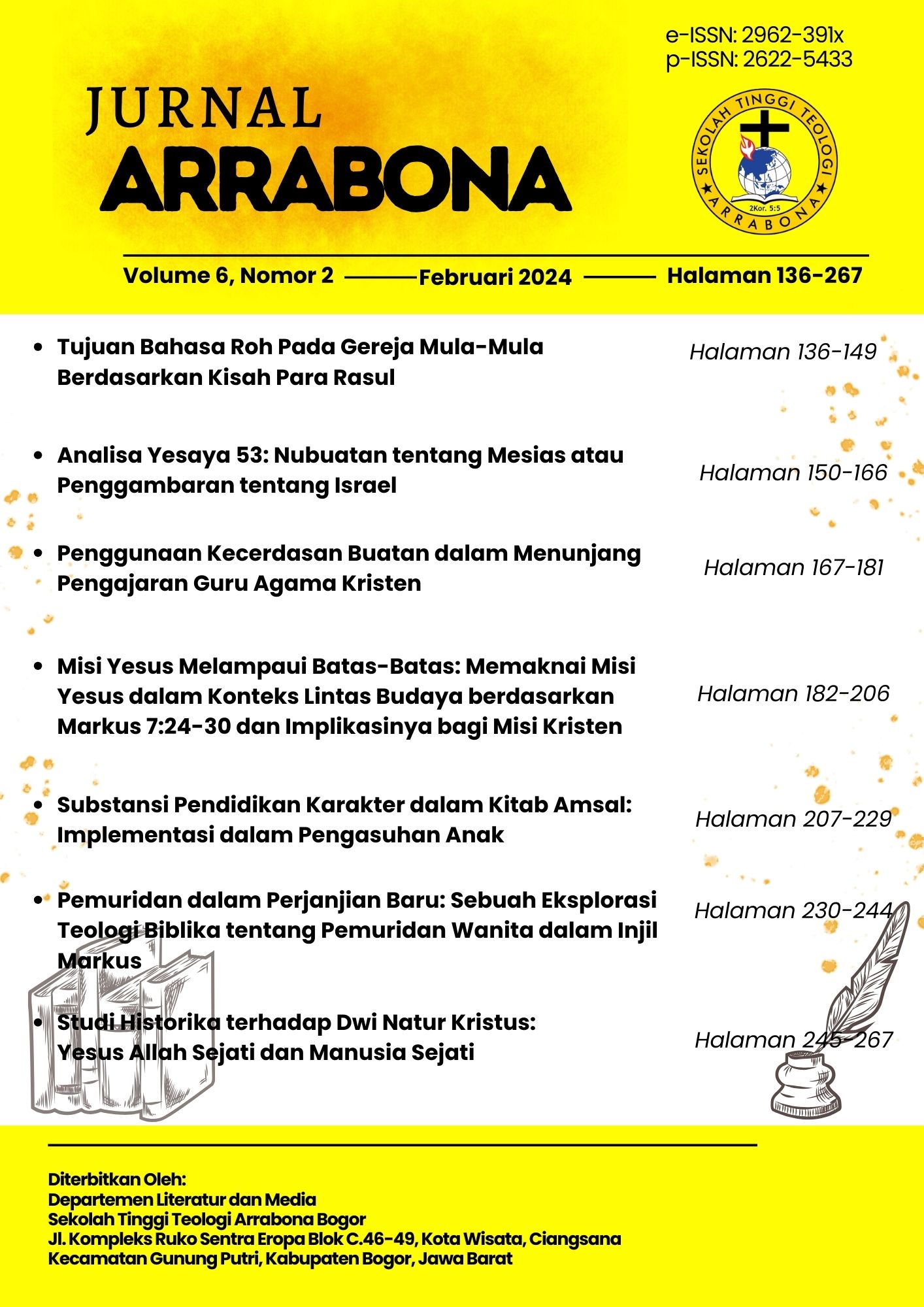
Penggunaan Kecerdasan Buatan dalam Menunjang Pengajaran Guru Agama Kristen
DOI:
https://doi.org/10.57058/juar.v6i2.80Keywords:
artificial intelligence, technology, teaching, christian religion teacherAbstract
The use of artificial intelligence in the context of Christian religious teaching is an important innovation that has the potential to increase the effectiveness and efficiency of learning. The background to the problem reflects the need to update Christian religious teaching methods to face the demands of technological developments. The research method used involves collecting qualitative data through observation, and implementing AI technology in the teaching process. The aim of this research is to evaluate the impact of using AI in supporting teachers' teaching of Christianity, analyze student responses, and investigate changes in their understanding and participation in Christian religion learning. The research results show that the application of AI can increase student engagement, personalize learning, and provide faster feedback to teachers. The implications of this research detail the concrete benefits of using AI in enhancing Christian religious learning experiences, while highlighting the challenges that may be faced in its application in religious education settings. This study contributes to further understanding of the potential of AI technology in improving Christian religious teaching methods in the digital era.
References
Admin Widya. “Jenis Kecerdasan Buatan (AI).” widya.
Daniel, Nuharama. “Pembimbing Pendidikan Agama Kristen.” jurnal Info media (2009).
Dewi, Athanasia Octaviani Puspita. “Kecerdasan Buatan sebagai Konsep Baru pada Perpustakaan.” Anuva: Jurnal Kajian Budaya, Perpustakaan, dan Informasi 4, no. 4 (2020).
Hakim, Lukman. “Peranan Kecerdasan Buatan (Artificial Intelligence) dalam Pendidikan.” Kemenristek Dirjen Guru dan Tenaga Kependidikan (2022).
Jaya, Hendra, Drs Sabran, M Pd, Muh Ma, Yasser A Djawad, M Sc, A Ilham, Ansari Saleh Ahmar, S Si, dan M Sc. Kecerdasan Buatan. Journal of Chemical Information and Modeling. Vol. 53, 2018.
Kurhayadi, Kurhayadi. “Artificial Intelligence (AI) Implementation in the Field of Public Administration in the Era of the Industrial Revolution 4.0 in Indonesia.” ijd-demos 4, no. 4 (2022).
Nainggolan, John M. “Guru Agama Kristen Sebagai Panggilan dan Profesi.” Info Media (2010).
Rantung, Djoys Anneke, dan Fredik Melkias Boiliu. “TEKNOLOGI DALAM PEMBELAJARAN PENDIDIKAN AGAMA KRISTEN YANG ANTISIPATIF DI ERA REVOLUSI INDUSRI 4.0.” Jurnal Shanan 4, no. 1 (2020).
Remegises danial Yohanis; Sozawato Telaumbanua; Samuel Siringo ringo; Mariyanti Adu; Yeheskiel Obehetan, Pandie. “Meretas Polarisasi Doktrin Kehidupan Jemaat Mula-Mula dan Implementasinya bagi Pendidikan Agama Kristen Keluarga Masa Kini.” Jurnal Arrabona 6, no. 1 (2023): 34–51. https://jurnal.sttarrabona.ac.id/JurnalSTTA/index.php/JUAR/article/view/81.
Robby Takdirillah. “Apa Itu Kecerdasan Buatan? Berikut Pengertian dan Contohnya.” Dicoding.
Sihotang, Hermanto. “Penggunaan Media Teknologi Informasi dalam Pembelajaran Pendidikan Agama Kristen di Masa Pandemi Covid-19.” IMMANUEL: Jurnal Teologi dan Pendidikan Kristen 1, no. 2 (2020).
Sugiono. Metode Penelitian Manajemen. Diedit oleh Setiyawami. 6 ed. Bandung: Alfabeta, 2018.
Suparno, Paul. “Menyikapi Penggunaan Artificial Intelligence ( AI, Kecerdasan Buatan) Dalam Pendidikan Fisika.” Seminar Pendidikan Nasional (2019).
Telaumbanua, Arozatulo. “Implementasi Pendidikan Agama Kristen di Era Tekonologi.” SANCTUM DOMINE: JURNAL TEOLOGI 9, no. 2 (2020).
———. “Profesionalisme Guru Agama Kristen dalam Membina Jemaat.” ILLUMINATE: Jurnal Teologi dan Pendidikan Kristiani 3, no. 1 (2020).
Threestayanti, Liana. “Contoh Penerapan Artificial Intelligence di Sektor Pendidikan.” https://infokomputer.grid.id/.
Downloads
Published
How to Cite
Issue
Section
License
Copyright (c) 2024 Jurnal Arrabona

This work is licensed under a Creative Commons Attribution-ShareAlike 4.0 International License.

This work is licensed under a Creative Commons Attribution 4.0 International License.